from 0 review
3 hours
Daily Tour
6 people
English, Russian


The spirit of Old Tbilisi lives in its delicate wooden balconies, the domes of its sulphur baths, and the remains of its ancient fortifications.
Tbilisi is a city you cannot truly discover through its landmarks alone. Its character lies in carved wooden balconies, brick walls, the domes of centuries-old baths, and narrow cobbled streets where history and everyday life exist side by side.
Join us for a walk through Old Tbilisi — a city where different eras, cultures and traditions have become wonderfully intertwined. Famous balconies hang above the streets, the aroma of freshly brewed coffee drifts from hidden lanes, worshippers come and go at historic churches, and small markets and local shops are still full of everyday city life.
We’ll begin with the history of Freedom Square, then make our way to the Leaning Tower beside Rezo Gabriadze’s famous puppet theatre and visit Anchiskhati, the oldest surviving church in Tbilisi. From there, we’ll continue to the Patriarch’s residence and the modern Bridge of Peace. At the monument to the Tamada, we’ll talk about Georgian feasting traditions and the culture of hospitality.
From here, we’ll head towards Meidan and the old bazaar, where the Eastern character of the Old Town is especially vivid. We’ll then explore the history of Narikala Fortress, which has towered over Tbilisi for centuries, and walk towards the Old Town Mosque — an important reminder of the multicultural and multi-faith history of Georgia’s capital.
We’ll wander through the old neighbourhoods, discover corners where stories of past centuries are hidden behind the façades, and talk about the churches, baths, fortifications and people who shaped and transformed this city.
In just a few hours, you won’t simply see the main symbols of Old Tbilisi — you’ll get a feel for its character: colourful, welcoming, full of different voices, and wonderfully alive.
| # | Discount group | From adult | To adult | Value |
|---|---|---|---|---|
| 1 | 2 adults | 2 | 2 | 80 |
| 2 | 3 adults | 3 | 3 | 160 |
| 3 | 4 adults | 4 | 4 | 220 |
| 4 | 5 adults | 5 | 5 | 280 |
| 5 | 6 adults | 6 | 6 | 340 |

Freedom Square is one of the main focal points of Tbilisi and a place where important events in the city’s history have unfolded over the centuries. At its center stands a column topped with a statue of St. George — one of the most recognizable symbols of Georgia’s modern capital. In December, festive lights transform the square into a giant Christmas postcard. Here, we’ll talk about how Tbilisi gradually expanded beyond its medieval fortifications and began to change rapidly in the 19th century. We’ll look at the historic buildings surrounding the square and recall the events that helped make this one of the city’s most important historical centers.
Fragments of the medieval walls of Tbilisi have survived right in the middle of the modern city. We’ll see them along Pushkin Street and Baratashvili Avenue and talk about where the boundaries of the old city once stood — and what Tbilisi looked like when life was concentrated within its fortified walls. We’ll also talk about architect Shota Kavlashvili, the chief architect of Tbilisi in the 1970s and 1980s, and his role in preserving the historic character of the Old Town. Thanks to the efforts of Kavlashvili and his colleagues, many historic buildings and surviving sections of the old fortifications were preserved during the large-scale redevelopment of central Tbilisi. This stop offers a chance to see the Old Town not simply as a beautiful architectural ensemble, but as the result of a major effort to preserve the city’s historic heritage.

Here we’ll find one of Tbilisi’s most unusual ticket offices — the famous Leaning Tower, created by theatre founder Rezo Gabriadze. Its whimsical appearance combines hand-painted ceramics, copper details and a tiny balcony reminiscent of a musical box. The tower has long been one of the most recognizable corners of Tbilisi. Twice a day, it comes to life with the miniature performance The Circle of Life: puppets appear, music begins to play, and the tower itself seems to become part of the show. Both the puppets and the musical accompaniment were created by Rezo Gabriadze. We’ll stop here to talk about the theatre, its creator and his unique world, where theatre, architecture, music and Tbilisi humour come together in one tiny corner of the city.
Anchiskhati is the oldest surviving church in Tbilisi, built in the 6th century, soon after the capital of Georgia was moved to Tbilisi. Today, the small church can seem almost hidden among the surrounding city streets, yet it preserves the memory of the earliest chapters in the history of the capital. Here, we’ll explore the origin of the name Anchiskhati, which is connected with the revered Anchi Icon of the Saviour, and the story of how this sacred image travelled from the Anchi Monastery in southern Georgia to Tbilisi. We’ll also look closely at the church’s architecture, its stonework and the traces of numerous reconstructions. This is one of the places where you can really sense just how ancient Tbilisi is — and how many layers of its history have survived within the modern city.
The residence of the Catholicos-Patriarch of Georgia stands on a site associated with the former royal palace. It is a place where you can trace how the role of Tbilisi’s historic center has changed over time: once a seat of royal power, it is now one of the important spiritual centers of the Georgian Orthodox Church. During our stop, we’ll talk about what the royal palace was like and why this part of Old Tbilisi became connected with two important chapters in the city’s history — the Georgian monarchy and the modern life of the Church.

Glass, steel and a sweeping futuristic form — the Bridge of Peace stands in striking contrast to the historic neighborhoods of Tbilisi. When it opened, it sparked plenty of debate: some admired its bold contemporary design, while others felt that the structure was too different from the city’s historic character. Today, the bridge has become one of Tbilisi’s most recognizable landmarks and a favorite spot for walks and photographs. As we cross the bridge, we’ll see Old Tbilisi from a different perspective: the riverbanks, historic houses, domes and Narikala Fortress come together in one panoramic view. Here, we’ll talk about the Italian architect Michele De Lucchi, who designed the Bridge of Peace, and discover some of his other notable projects in Tbilisi.
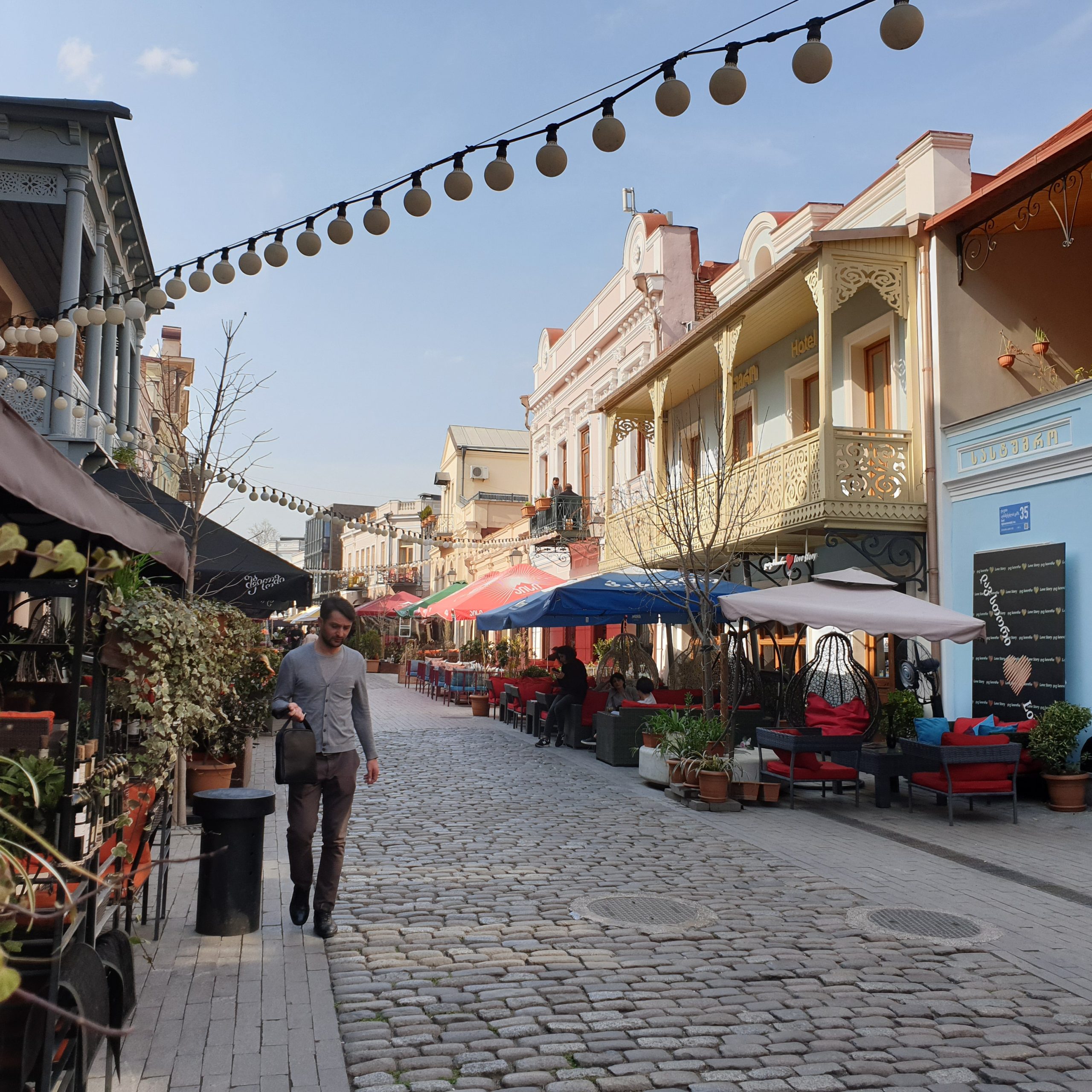
We’ll walk along a street that recalls the time when Tbilisi was an important stop on the trade routes between East and West. Caravanserais once stood here — inns for merchants and travelers where they could stay, store their goods, feed their horses and continue their journey. We’ll talk about how trade shaped life in Old Tbilisi and why the city attracted merchants, craftsmen and travelers from different parts of the world for centuries. From here, we’ll make our way to Sioni Cathedral, one of the most important churches in Tbilisi. Its history reaches deep into the medieval period, while its present appearance was shaped over many centuries. We’ll explore the cathedral’s history and its significance to the Georgian Orthodox Church. What makes this area especially fascinating is that, within a very small space, traces of different sides of old Tbilisi have survived side by side — its commercial, religious and everyday life.

At the small bronze statue of the Tamada, we’ll explore one of Georgia’s best-known traditions — the Georgian feast. Why is a tamada much more than simply someone who makes toasts? How does a traditional Georgian feast work? Who is toasted, in what order, and why can a good toast turn into a little story of its own? We’ll look at the traditions and unwritten rules of the Georgian feast, talk about the supra, the role of the tamada, and the art of making a memorable toast. And, of course, we’ll take a closer look at the Tamada himself — a figure that has become one of the most recognizable symbols of Tbilisi’s culture.

From Meidan, we have one of the best views of Narikala Fortress, the ancient citadel rising above Old Tbilisi. Here, we’ll look at its strategic position and talk about why this particular location was so important to the city. Narikala’s history stretches back many centuries. The fortress was repeatedly destroyed and rebuilt, witnessed changes of rulers, and remained one of Tbilisi’s most important defensive strongholds. We’ll explore how the fortress changed over time, where its name came from, and what events left their mark on its history. At the same time, we’ll take in the view from Meidan and see how the fortress, the river and the old city neighborhoods were all connected.
On the slopes below Narikala stands the Juma Mosque, one of the most distinctive landmarks of Old Tbilisi. Its minaret and brick façade blend naturally into the historic cityscape, while the mosque itself is an important part of Tbilisi’s multi-faith history. Here, we’ll talk about Tbilisi’s Muslim community, the history of the mosque, and how different religious communities lived side by side for centuries — alongside Orthodox churches, synagogues and Armenian churches. From here, we’ll once again look across the surrounding neighborhoods and explore why Tbilisi has remained, throughout its history, a city where different peoples, languages, religions and traditions have met.

It is hard to believe that in the very heart of Old Tbilisi, surrounded by fortifications, sulphur baths and historic houses, you can suddenly find yourself in what feels almost like a natural gorge. We’ll walk through the Fig Gorge, hidden at the foot of Narikala, and reach a small waterfall — a place where the sounds of the city seem to fade away, replaced by running water and the sounds of nature. We’ll talk about where the gorge got its name, how this little natural corner is connected to Tbilisi’s history, and why water has always played such an important role in the life of the city. It’s a small but refreshing change of scenery: after fortresses, churches and historic streets, a moment of nature right in the heart of Old Tbilisi.
Our walk will end in one of the most recognisable corners of Old Tbilisi — the Sulphur Baths District.
Low brick domes, warm steam and the distinctive scent of the sulphur springs evoke the legendary story of how Tbilisi came to be. Here, we’ll talk about the city’s famous sulphur baths, their role in Tbilisi’s everyday life, and why people have been coming here for centuries — not only from the city itself, but from across the Caucasus.
It’s the perfect place to bring our walk to a close. Over the course of a few hours, we’ll have travelled through different chapters of Tbilisi’s history — from ancient churches and medieval fortifications to the city’s modern landmarks.
And the sulphur baths bring us almost full circle, back to the very beginning of the capital’s story: its hot springs and the legendary birth of Tbilisi.
0 review